.png)
Every product and engineering team we talked to hit the same wall: the science behind portable markerless motion capture exists, but making it reliable and production-ready is an entirely different problem. One that typically means hiring specialized computer vision and biomechanics teams, building validation infrastructure, and maintaining it reliably — everything we've spent years to build at Model Health.
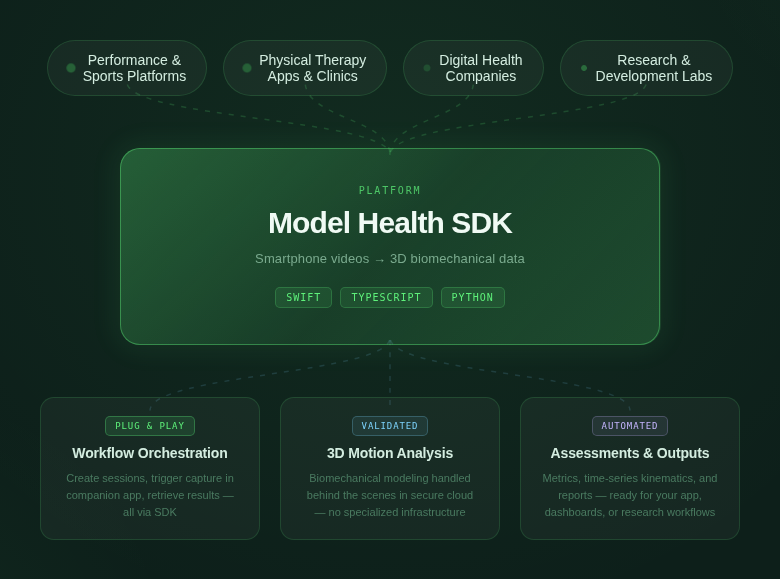
Today, we're launching the Model Health SDK. It gives any company accurate and plug-and-play movement analysis from smartphone video — delivered through a structured API.
Below, we cover what it does, how integration works, and three deployment patterns we're already seeing across health and sports organizations.
What the Model Health SDK provides
The Model Health SDK gives product and engineering teams programmatic access to a validated markerless motion analysis pipeline without requiring them to build or maintain the underlying computer vision and biomechanics infrastructure.
The integration surface has three operations:
- Capture — Control recording sessions directly from your application, with guided flows that produce consistent, reliable input data.
- Analyze — Trigger motion analysis asynchronously via the SDK. Processing scales with your workload, and status updates are returned alongside results.
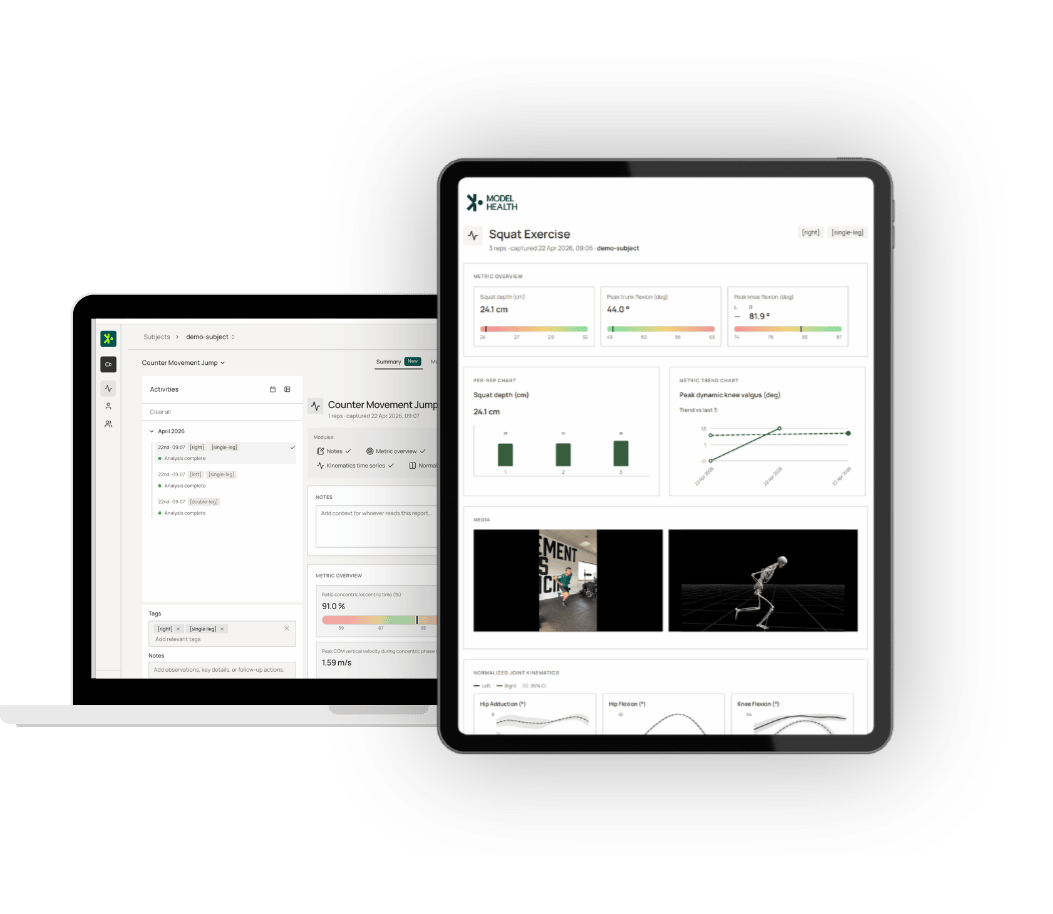
- Import — Retrieve structured outputs—high-level metrics or 3D biomechanical data—and route them into your dashboards, reports, assessments, or backend systems.
Current language support includes TypeScript (browser and Node.js) and Swift (iOS, iPhone and iPad). Python support is coming soon.

Video recording requires the Model Health Companion app. All other SDK operations—creating sessions, triggering analysis, retrieving results—work across iOS, web, and backend environments.
Three integration patterns
Organizations embed the Model Health SDK for different reasons. Below are the three most common deployment patterns, each representing a distinct build-versus-buy decision.
1. Building a vertical product without a motion capture team
Consider a company building software for the running market: coaching tools, injury prevention, performance tracking. The core product insight exists. The distribution strategy is clear. What's missing is a markerless motion capture system—the kind that typically requires months of computer vision development, ongoing model validation, and biomechanics domain expertise to maintain.
The SDK provides that capability as a dependency rather than a build requirement. Your team focuses on product workflows, UX, and the specific needs of your user segment. The motion analysis layer is handled.
This is a meaningful distinction. Markerless motion capture is difficult to get right across varying recording conditions, subject populations, and movement tasks. Validated accuracy at scale is not a one-time problem—it requires continuous maintenance. The SDK offloads that responsibility.
2. Adding motion analysis to an existing product portfolio
For organizations already selling connected devices or software in the sports and health space, motion analysis from video represents a natural portfolio extension—with or without direct integration into existing products.
The SDK is designed to fit your current architecture. Outputs can feed into existing dashboards and reporting views, populate longitudinal tracking features, or power standalone assessments within your platform. The integration doesn't require rebuilding your stack; it adds a capability layer that sits alongside what you've already built.
For teams exploring synergies with existing hardware or data streams, the structured API outputs are ready for use in analytics pipelines or machine learning workflows.
3. Populating an internal database or EMR from an external collection tool
Clinics, rehabilitation providers, sports medicine organizations, and athletic programs often have established electronic medical records systems, athletic management systems (AMS), or internal databases. Standing up a new application for data collection creates friction—staff training, workflow disruption, and a parallel system that requires ongoing reconciliation.
A common deployment pattern here is to use the Model Health platform as the collection and analysis interface while using the SDK to automatically route results back into the organization's existing systems. Clinicians and athletic staff collect and review motion data within the Model Health environment. Results flow into the internal EMR, AMS, or database via the SDK without requiring staff to manage duplicate entry or file exports.
This approach preserves existing clinical and athletic workflows while adding motion data as a structured input.
From pilot to production in days
Demoing markerless motion capture is easy. Scaling it reliably is where the real work is.
"We've seen what breaks in production — variability in recording conditions, subject demographics, movement types — and our validation pipeline is built around those realities, not controlled lab conditions."
Integration teams get structured support from day one: reference architecture, example applications, and code snippets to accelerate early development. A complete integration typically takes an experienced developer less than a week.
Let's talk
The Model Health SDK is available now. Documentation is at docs.modelhealth.io.
SDK access is available to Model Health subscribers and requires an API key. To request access and discuss your integration requirements—whether you're in early product design or ready to begin a pilot—book a demo or reach out directly.

).png)
.png)