Within a few months, Biomech's R&D team used the Model Health SDK to build a Windows application that guides athletes through a sequence of tests, runs 3D analysis automatically, and sends the results to the club's athlete management system.
Biomech Solutions supplies, installs and trains teams on biomechanical measurement technology from its base near Madrid, as part of the Rivas Group. Its expertise spans force plates, inertial and optical motion capture, electromyography and analysis software, and its sports work includes force plate assessments with the Spanish women's national football team.
This is the story of how a team used to cables, wands and L-frames rebuilt its product around a phone and a tablet, without compromising quality.
Where Biomech started
Biomech knows lab-grade equipment well, and its first in-house motion capture system, called Automatic Screening Room (ASR), was built the way motion labs have always been built. Industrial cameras were cabled to a central workstation and calibrated with traditional mocap wands and L-frames. The data was good. Getting to it was slow and tedious.
That trade-off worked in research. It did not work for the customers Biomech wanted to serve: professional football clubs that need to screen an entire squad before and after every training session or game. Or a coach who wants a clear read on an athlete before the next session.
"We were used to complex setups and complex software, or research-oriented tools that made it hard to screen several athletes in a short time and get relevant KPIs immediately. What we wanted to offer was a non-invasive way to quantify biomechanics, without placing sensors and without a system that takes hours to set up." Daniel Iordanov, Innovation Director, Biomech
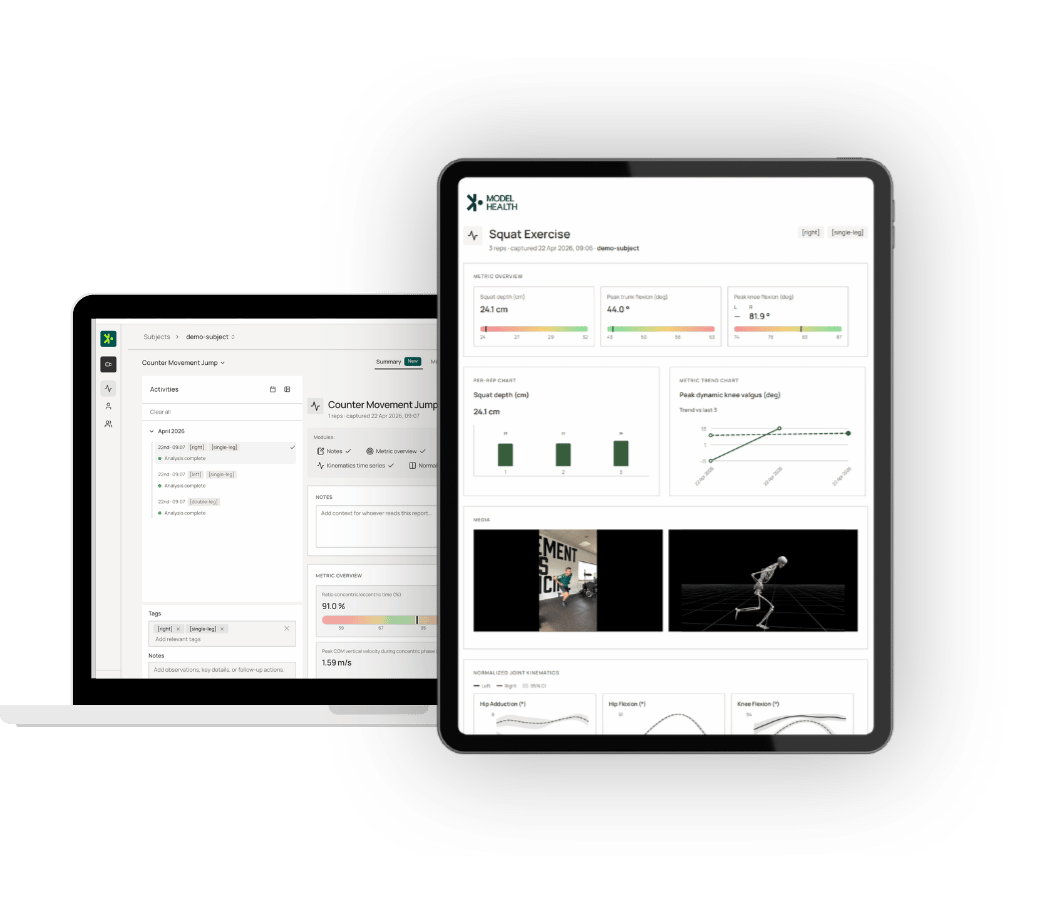
Biomech had already been using the Model Health native app and dashboard. The team trusted the 3D tracking and found the quantitative KPIs useful for assessing both performance and injury risk. What it needed next was control over the experience around that tracking for their specific use case: a customizable experience, with video instructions, its own reports and fast capture.
From first test to full software in a few months
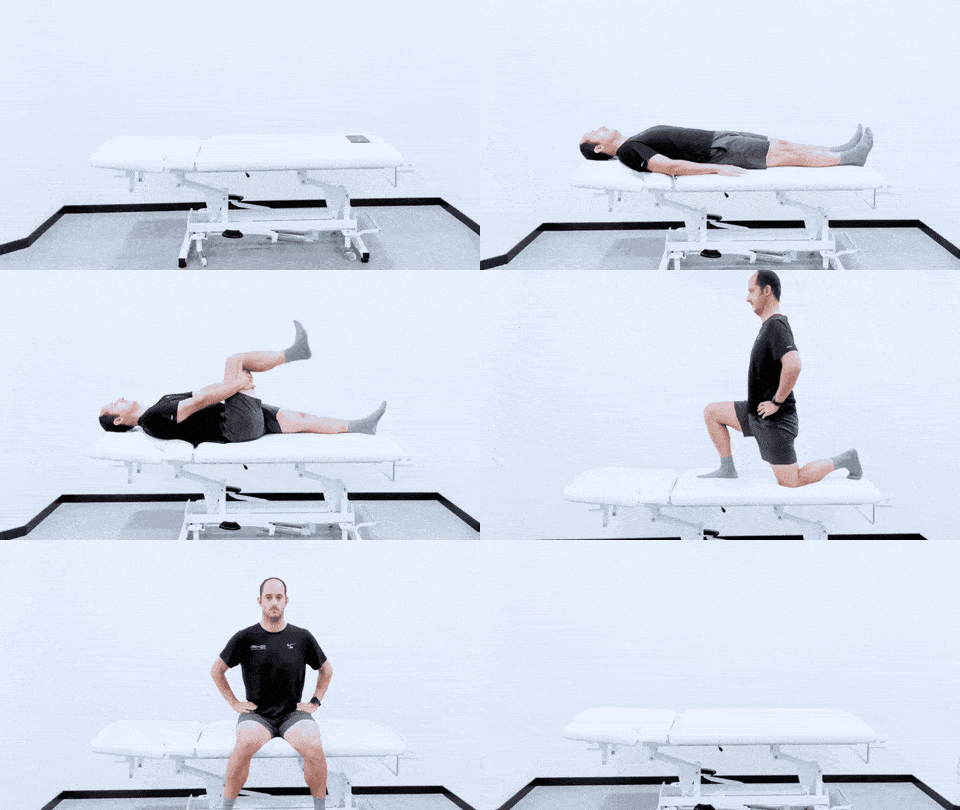
Model Health offered Biomech access to the SDK in May 2026. By June, the team was running its first tests and building basic pipelines that took a recording from scratch to the default PDF report for Model Health's predefined activities. By October, those pipelines had grown into a complete Windows application.
"From the first time, the SDK was very easy to understand and work with. We also saw in Model Health a team that was really committed to developing and updating its product, which mattered to us as a long-term partner." Daniel Iordanov, Innovation Director, Biomech
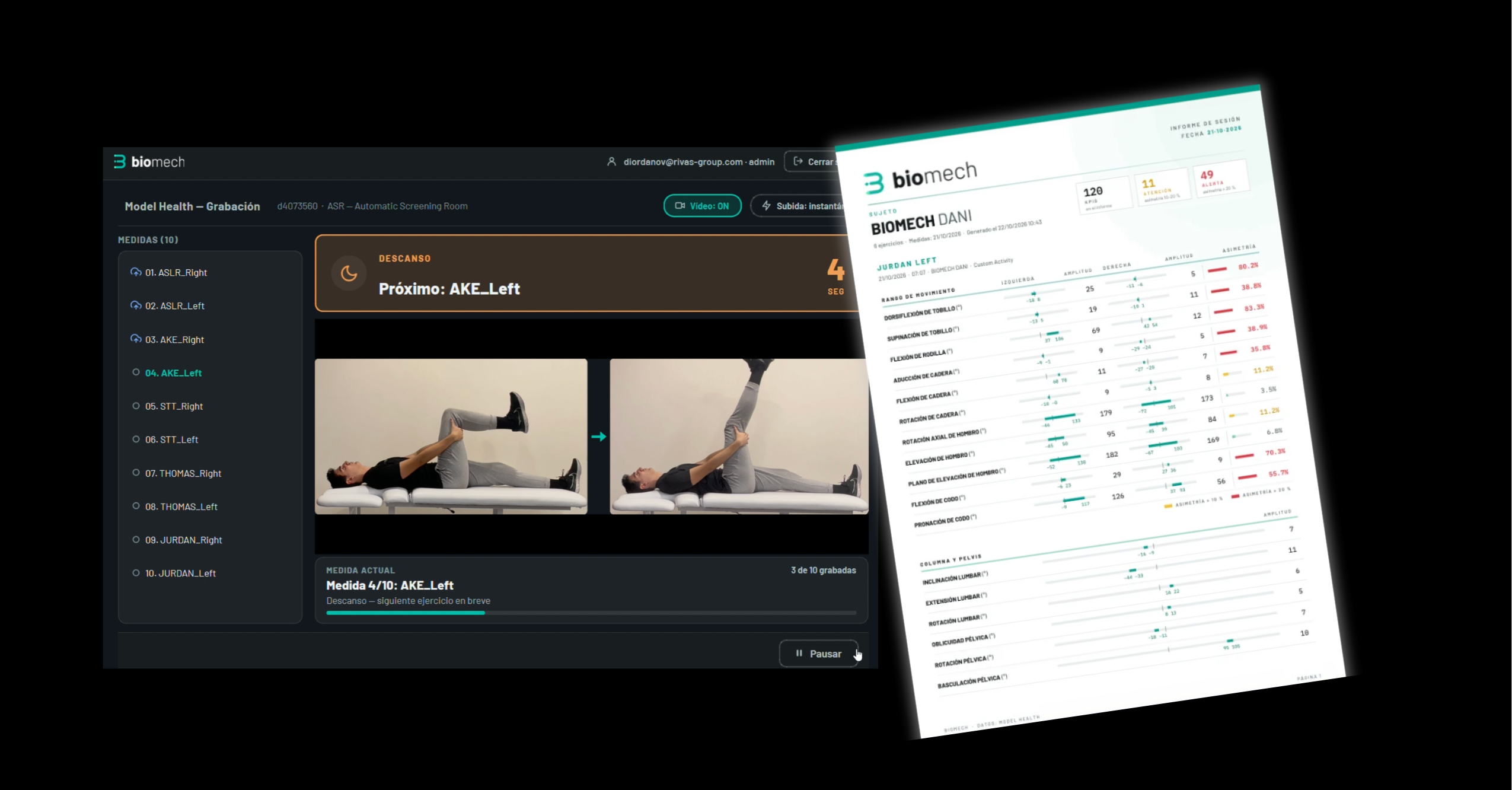
The workflow Biomech designed is short by intent. An operator calibrates, picks a protocol, and the athlete works through a sequence of exercises with instructions and a reference video on screen. When the sequence ends, the analysis runs on Model Health's servers and the results come back as a customized report and as structured data, pushed into whatever framework the customer already uses.
The SDK's flexibility also gave Biomech room to build its own biomechanical analysis on top. The team can work with raw tracking data, or with analyzed outputs that already include extracted KPIs and normative values.
"The SDK has been a key point for creating our own biomechanical analysis. It is extremely flexible and lets us use both the raw tracking data and the analyzed data with KPIs and normative values." Daniel Iordanov, Innovation Director, Biomech
What building on the SDK saved
The savings showed up in three places: the hardware Biomech no longer ships, the models it never had to build, and the minutes it took out of every session.
Hardware. The industrial cameras, cabling and workstation behind ASR are gone. Capture now runs on smartphones and a tablet.
Engineering. Biomech set aside the idea of training its own neural networks for keypoint labelling and 3D tracking, along with the work of deploying and running that infrastructure locally or in the cloud.
"We saved months by discarding the idea of developing our own ML models for labelling and tracking, and all the time it would have taken to deploy such a solution, locally or in the cloud. That deployment is a cost in itself." Daniel Iordanov, Innovation Director, Biomech
Time per session. Using the SDK, Biomech automated many of the steps a clinician would otherwise perform in the Model Health web app. The workflow was optimized to be operated by the athlete himself, requiring fewer, automated steps. Shorter waits and also mean a session goes from setup to an uploaded result faster, for Biomech's team and for its customers.
"We have our own reduced version of the Model Health web app, much more focused on the athlete’s own workflow and for a quick result pushed into the AMS or the sports data framework of the club or center." Daniel Iordanov, Innovation Director, Biomech
Opening new markets
The new software has opened markets Biomech could not reach before. Some organizations had little or no time for biomechanics assessment. Others could only run tests with an expert supervising every repetition. Guided protocols change that.
"Now we offer sports professionals the ability to run biomechanics assessments unsupervised, and to focus their time afterwards on working with the athlete, using quantitative and validated results." Daniel Iordanov, Innovation Director, Biomech
What comes next
Biomech presented a beta of the software at a workshop on 1 October 2026, and the commercial launch is planned for January 2027.
The early signal on engagement is encouraging. Users see a finished product that cuts the time they spend supervising exercises and processing data, and they put that time back into treating and training their athletes.
About the Model Health SDK
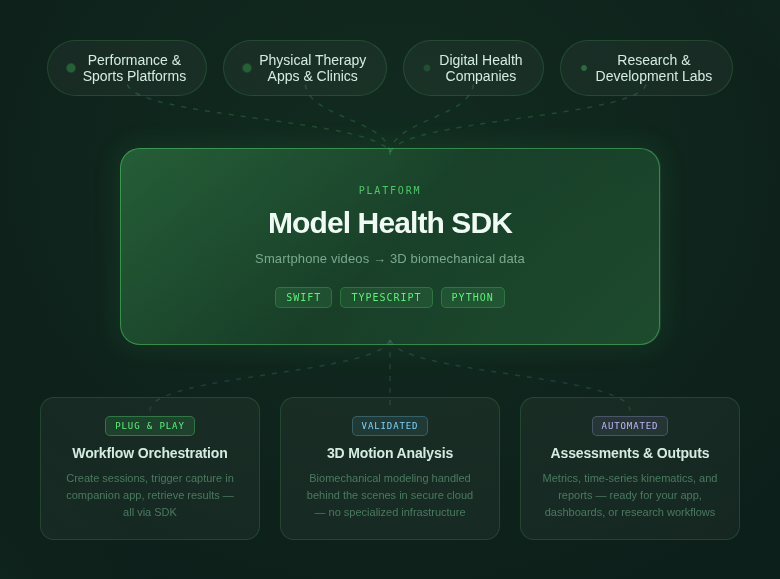
The Model Health SDK lets product teams add validated 3D movement analysis from smartphone video to their own software. It is available for Swift, TypeScript and Python, and returns raw kinematics, automated KPIs and normative benchmarks that can feed dashboards, reports and backends. It is built on OpenCap, the markerless motion capture research developed at Stanford. Teams interested in building on it can request access or Book a demo with us.

).png)